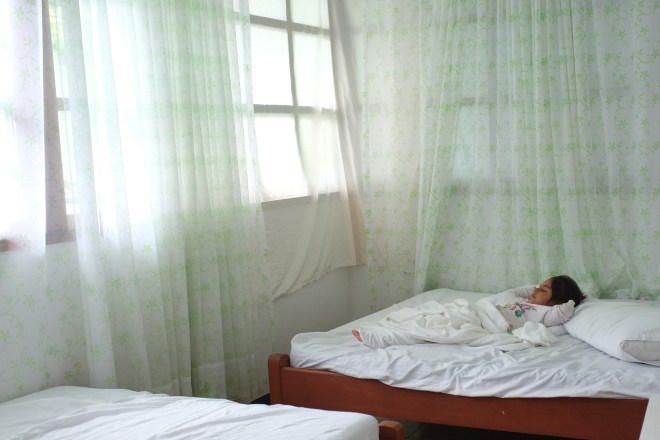
J’ai violé l’amazonie – I violated amazonia

Pour passer du Brésil à la Colombie, l’option la moins chère était prendre un premier vol de Manaus à Tabatinga, petite ville Brésilienne à la frontière colombienne, puis de  traverser la frontière à pied, passer ensuite deux jours à Leticia, petite ville colombienne de l’autre côté de la frontière, avant de reprendre un avion vers le nord de la Colombie ou nous souhaitions aller.  Leticia s’est révélée être une jolie petite ville, relativement touristique, au milieu de la forêt amazonienne. A notre hôtel, on nous a proposé une excursion en bateau, en direction de la jungle, ou nous étions quasi assurés de voir plein d’animaux. Charmés par l’idée, mes compagnons de voyage et moi avons accepté. Cependant, nous nous sommes vite rendus compte de l’attrape-touriste standard: ils nous ont emmenés à une petite maison qui se prétendait être un centre de protection des animaux, et ou nous avons pu à notre guise observer, photographier et même toucher des aras (qui ne volaient pas) des paresseux (qui ne dormaient pas tranquillement sur leurs arbres), et un énorme serpent. Mon cœur d’enfant s’est ravi de prendre dans les bras le paresseux, cette boule de poil improbable, lente, aux  bras disproportionnés et à la coupe de cheveux de Mireille Matthieu. Cependant, après avoir posé quelques questions, nous avons bien soupçonné que les-dits paresseux, soit-disant tombés du nid et recueillis pour leur bien, ont probablement été arrachés à leur forêt afin de faire venir les touristes et tourner le business. Autant dire que je me suis sentie un peu comme si j’avais violé l’Amazonie. J’ai tenté de me réconforter en me disant qu’un paresseux qui se fait caresser toute la journée par des touristes, vu son caractère câlin et lent au possible, est surement moins malheureux qu’un tigre dans le même rôle; cependant, je n’ai pas pu m’ôter de la tête l’idée que ce genre de business arrache à la forêt des animaux qui devraient s’y promener (ou y dormir toute la journée) librement. On ne m’y prendra plus, ma fois.


To go from Brazil to Colombia, the cheapest option was to first take a flight to Tabatinga, small braziliand city close to colombian south border, then to cross the border walking from that city to Leticia, where we spent two days, and then to take a second flight to north Colombia. Leticia was a lovely little city, a little bit too touristic, but sweet, and in the middle of amazonian jungle. Our hostel suggested us to go for an excursion with a boat in the jungle, and told that with that one we will see a lot of amazonian animals. We liked the idea and accpeted, but then see it was just a trap for tourist. They brought us to a small « animal protection center », where we could see aras (not able to fly) and see, photography and even touch sloth (not in there trees and not sleeping all the day quietly). My inner child was really happy to embrace those cute and fluffy and extremly slow animals with huge arms and weird smiling head. But I was able to feel that it’s highly probable that those animals are note here because for their protection but probably here just to attract tourist and make money… instead of being in the jungle. I felt as I violated amazonia. It’s not the way I want to visit countries and I felst disrespectful to nature. I tried to tell myself that a sloth that is cuddeled all the day by tourist is not as unhappy as a tiger in the same position, but still, I would have prefere him free.

Le terminal – The Terminal

Mes compagnons de voyage et moi nous sommes retrouvés coincés en Amazonie par le carnaval. Le bateau que nous devions prendre étant annulé, le suivant dans plusieurs jours, et nos premières impressions carnavalesque amazoniennes nous ayant donné envie de fuir celui-ci plutôt que nous y attarder, nous avons décidé de prendre un vol. Arrivés à l’aéroport, nous avons pu négocier un aller simple pour la Colombie à prix correct pour le lendemain. Il nous restait donc 24h à tuer, plus vraiment de réals, la monnaie locale, mais des vivres et des fruits prévus pour plusieurs jours de bateau. Nous avons donc campé dans l’aéroport, avec une grosse pensée pour le film « le terminal ». La vie de gitans, on pose le camp dans le terminal, une séances d’acroyoga interrompue par le personnel de l’aéroport, non pas pour nous chasser mais pour nous demander de nous photographier, nos premiers 7 reals gagnés ainsi pour cette prestation publique (plus ou moins 2 chf), un footing sur le parking de l’aéroport qui m’aura rappelé les échauffements en competition de judo, du stretching, une nuit dans un coin tranquille sur nos nattes de sol, un guacamole de compétition avec un avocat gros comme ça, encore des jus d’Acaï – nos derniers ! – , puis enfin passer la sécurité et embarquer pour la Colombie ou la suite des aventures nous attendent.

———————–

My travel companions and me get blocked in Amazonia for the Carnaval. The boat we were supposed to get was canceled, and our first carnavalian impression make us want to go away more than to stay for it. We went to the Manaus airport – yes, even Amazonian cities are huge, modern, and have an airport – and found a flight for Colombia with a correct price for the next day. So we were in that airport for 24 hours, with no Brazilian money anymore, but food and fruices that we bought earlier planning a couple of days of the boat. We began to camp in that airport with a though for the movie « The Terminal ». Modern gypsie life, an acroyoga session in the terminal, interrupted by airport employees, not to ask us to stop it and go somewhere else but to ask for taking pictures, our first 7 reals (around 2 usd) won with street performance with it, a run in the car parc outside that remembered me the warm up of judo competitions, stretching, a night sleeping on our yoga mats, a huge guacamole, a last Acaï juice before we went through the security check, direction Colombia for new adventures.


Presidente Figuereiro, le pays des cascades – Presidente Figuereiro, land of waterfalls

Presidente Figuereiro, petit village au milieu de l’amazone, m’aura donné la joie de me baigner dans des rivières – rio en portugais – d’une couleur ocre et or, de m’y laisser flotter et descendre entre les arbres au son des insectes et oiseaux, maîtres en ces lieux. Aras et autres volants colorés, colibris, papillons, nous auront enchantés à la vue de leurs plumes et de leurs parades aériennes. Quelques belles rencontres, un bain d’argile nous transformant en Golems, un bébé chat qui tète une chienne qui l’a adoptée, des randonnées sous le soleil et dans la jungle, et encore des tonnes de jus d’Acaï.

———–

Presidente Figuereiro, small village in the middle of the Amazonia, teached me the happiness of taking a bath in a red and yellowish river – rio in Portuguese – and to let me float and go down in the sound of insects and birds, masters of that place. Aras and other little flying wonders such as colibris or butterfly showed their colors and aerial dances. Some beautiful human souls, a clay bath, a baby cat adopted by a dog,  walks in the jungle and under the sun, and again a ton of Acaï juices.
Cigale et fourmi – let me sing

La Rue Ketanou chante:

« Je ne sais pas où je vais, Et ça je l’ai jamais bien su, Mais si jamais je le savais, Je crois bien que je n’irais plus, Aujourd’hui je t’aime, Oui mais demain, On ne peut jamais être sur de rien, On va toujours seul sur la route, Je continue coûte que que coûte, Et puis une route en croise une autre, Et puis une autre et encore une autre , Pourvu que la tienne oh mon amour, croise la mienne tous les jours. Je ne sais pas où je vais, Et ça je l’ai jamais bien su, Mais si jamais je le savais, Je crois bien que je n’irais plus, Et je suis une cigale, T’inquiète fourmi je crève pas la dalle, La musique c’est un bon gagne pain, Ou que je sois je ne manque de rien, Je chante toujours de quoi grailler, De quoi trinquer de quoi causer, Je m’endors ou il fait sommeil, Et je passe l’été au Soleil . « 

Après 1 an de voyage, travaillé 4 mois avant de repartir à l’aventure sans billet de retour, j’avoue que l’autre jour, marchant sous la lune et les étoiles le long d’une plage de sable blanc au bord de l’amazone, je me suis demandée si j’avais vraiment droit à ces joies là, si je ne devrais pas un peu réviser ma poésie de la cigale et de la fourmi. Retour de la pensée Suisse « mais il faut travailler! ». Je ne sais même pas vraiment où je vais.  Dialogues interne. J’ai un métier, que j’aime vraiment en plus, j’ai de l’argent de côté, alors fourmi, cesse de m’ennuyer et laisse-moi chanter. Et ma fois si à l’hiver je n’ai pas engrangé assez de provisions, j’irai voir de l’autre côté de l’océan là où c’est encore l’été. J’irai voir ou me mène mes rêves. Pour l’instant j’applique tout en douceur le simple et beau « l’important c’est d’être avec des gens qu’on aime. » Pour la suite, j’ai des projets d’acroyoga, des rêves de bateau stop transatlantique, d’escalade et de cirque. Le reste suivra. C’est ça aussi le voyage, s’abandonner avec confiance en la route. Inch’alla qu’il disait.

————

After 1 year of travels, working as a physical therapist for 4 month before I went on the road again, without a return ticket, I have to say that last night, walking under the star on à with sand beach among the amazone river, I asked myself if all this happiness was real. I asked myself if I should study again the stories of the ant and the cricket of « La Fontaine » where the cricket dog all the summer and the ant work hard. When winter arrive, the ant have food and the cricket cry. Back on the Swiss thought « you have to work! » I don’t even really know where I go. Intern dialog. I have a profession, that I love, I have money on the side, so please little working ant, let me sing. If in winter I don’t have enough food I will have a look at the other side of the ocean if ’tis summer there. I will see where my dreams bring me. Right now I just experience the saying « the important is to be with people you love ». Later, I have dreams of acroyoga, transatlantic sailing, climbing and circus. That’s a part of the travelling process, acceptance, letting go, surrender with faith and truth to the road. Inch’alla he used to say.

Attempt to translate a french song named « Where I go » – « Où je vais » from « La Rue Ketanou »:

« I don’t know where I go, And I have never really known that, But if I would have known, I think that I will not go anymore, Today I love you, Yes, but tomorrow, One can never now, One are always alone on the road, So I keep going and going, And then a road cross another one, And another one and another again, I hope than yours, my love, will cross mine again everyday.

I don’t know where I go, And I have never really known that, But if I would have known, I think that I will not go anymore, I am a cricket, But don’t be worried ant I’am not hungry, Music is a good way to eat, Wherever I go I’m not in need, I sing enough to eat, Enough to drink enough to talk, I fall asleep where I am sleepy, And spent summertime in the sun. »


img_6567

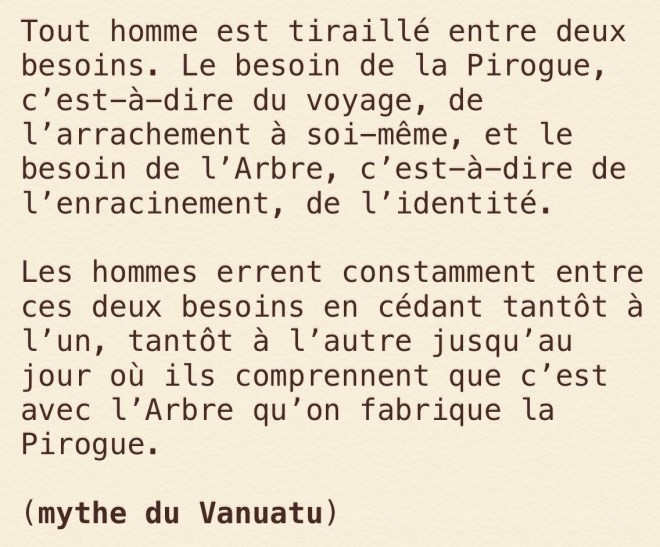
Everyone is struggling between two needs. The need of Pirogue, what means need of travelling, to go outside of yourself, and the need of the Tree, needs of roots and identity. People use to wander between both, one day more close to one and one day more close to the other, until they understand that it’s with the tree that you build the pirogue.