Plumes déliées, anachronies et anarchies. Du café et de la poésie. Printemps pour rien; printemps pour tout. Avec tout ça, dites moi, on va où? Jsais pas bien, printempis. Les oiseaux de nos désespoirs s’oublient en pépillant. Les papillons s’en battent les ailes. Mélancolie du temps qui semble ne pas passer. Et pourtant, doux spleen de mes journées, me fait écrire, me fait rêver à un demain plus coloré. Printemps du printemps, je t’attendrai. Puisqu’on ne peut pas toujours se battre il parait.
Untied feather, anachrony and anarchy, coffee and poetry, spring of nothing, spring of everything. With all that tell me where we go. I don’t know, spring anyway. The birds of our despair forget each other; he butterflies wings flap. Melancholy of time which doesn’t seem to pass. Nevertheless, sweet spleen of my days makes me write makes me dream to a more colorful tomorrow. Spring of spring I will wait for you
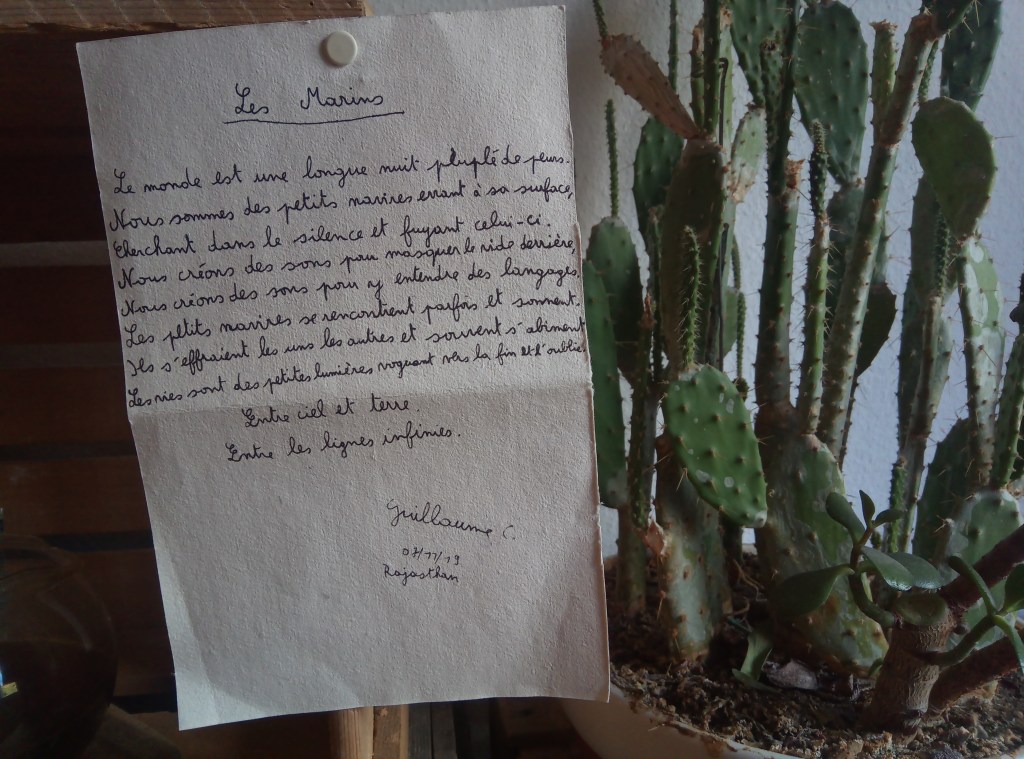
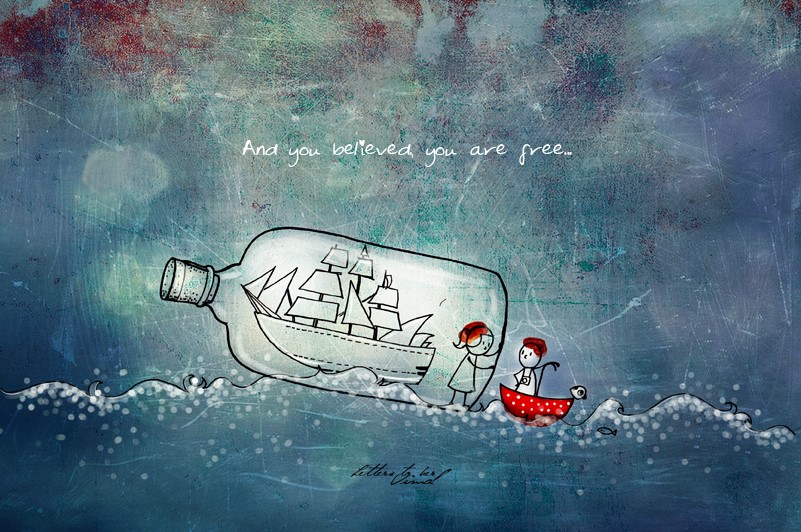
Le monde est une longue nuit peuplée de peurs. Nous sommes des petits navires errant à sa surface, cherchant dans le silence et fuyant celui-ci. Nous créons des sons pour masquer le vide derrière. Nous créons des sons pour y entendre des langages. Les petits navires se rencontrent parfois et sonnent. Ils s’effraient les uns les autres et souvent s’abîment. Les vies sont de petites lumières voguant vers la fin et l’oubli.
Entre ciel et terre
Entre les lignes infinies
Guillaume Chenier
Retrouvez ses poèmes dans le recueil « Astre du matin » que vous pouvez commander en ligne
Seamen
The world is a long night full of fears. We are small ships wandering on its surface. Seeking in silence and fleeing this one. We create sounds to hide the void behind. We create sounds to hear languages. Small ships meet sometimes and ring. They scare each other and often become damaged. Lives are small lights sailing towards the end and forgetting about it.
Between heaven and earth. Between the infinite lines.
Guillaume Chenier
More poems and text in his book « Morning Star » that you can find and order on the internet.
To escape from reality, just on moment, enjoying the present time, forget, pretend. A step backwards for step forward. Getting some momentum, let’s say. To slow down to look for, to search. And then you just don’t get it. Because, maybe there is nothing to find out. Insolence of the one who is searching, thinking he already knows. Unendless dance of everyday, hollow wave and other hope. Here and there. It goes away. Ever and ever, it goes away. As certain as the setting sun. After the night, daylight. Always. Ancient celestial body. Until the day where. No obvious sens, charming, heady everyday looking for and not finding. As a child game. Just let the time passes. He knows, him, I think.
S’échapper de la réalité, l’espace d’un instant, profiter du moment, oublier, faire semblant. Reculer pour avancer. Prendre de l’élan, en vrai. Ralentir pour regarder, chercher. Ne pas trouver. Insolence de celui qui cherche, il cherche et il croit savoir. Eternelle danse du quotidien, creux des vagues et autres espoirs. Mirages. Lumières du matin. Renouveau. Il vient de où l’espoir. Ici et là bas. Il s’en va. Toujours il s’en va. Aussi sûr que le soleil se couche. Après la nuit, le jour. Toujours. Astre ancient. Jusqu’au jour où. Pas de sens apparent, charmant, enivrant quotidien à chercher et ne pas trouver. Jeux d’enfants. Laisser le temps. Il sait, lui, je crois.
Snapchat and insight of a normal day here in Samos Med EqualiTeam clinic, on a Greek refugee camp, as a physiotherapist:
« My day begin with a woman victim of torture one year ago, his collarbone was broken and didn’t really healed properly. The pain is too big and I cannot even touch or mobilize her shoulder. I feel helpless. I work around that join to help to decrease the tension and pain, working on her neck, back, some breathing exercices. Slowly going to the shoulder. Pain sometime is like a wild animal you try to tame. She talk to me, I listen to her, I am here for her, with her. Later, as a french-english interpreter for one of our doctors, I have to explain to a patient we have to open his infected and painful abscess, to take out the pus, but that we don’t have anesthetic here and that the hospital will not take him because his case is not an emergency. So we gonna give him 1g of Paracetamol, and I will hold his arms when the doctor will do the cut with a scalpel, that he don’t move and hurt himself, or hurt the doctor. I hold him, talk to him, try to reassure him. It’s painful. But he managed to do it. The same day, I see behind the rooms a patient waiting for doctor, cuts open and bleeding on his forearm. Suicide attempt, self harm? A shout for help in any case. He doesn’t look good. We will take care of him soon. Its hard to listen too, and hard to see. It make me feel angry, and sad. But angriness cover the sadness and tiredness. Angriness give me strength to fight for them, to give those people my time and my knowledge on body and pain. Some medical help, but as well some attention, softness and kindness. Just a smile sometime help to briefly lighten the day.
There are some easy cases as well, patient we can help, patient who will go better pretty soon with our cares here in the clinic. Some beautiful surprises as well, like this patient burned on the two hands and forearm who recovered way faster than expected. 15 days after the accident the wounds are clean and the mobility of fingers and wrist is really good. It give me so much joy, it give me so much hope. Sometime after the day of work I meet some patients in the street, for exemple last day one afghan man that was so happy I was able to tell him « Salam, khoubi? Khoubam. » (« Hello, how are you? I’am good » in farsi). Or when I see again some patients I treated and who tell me they are getting better, or are thankfull for our kindness and availability in the clinic.
Spending time with the other volunteers is a great support for hope, some are from all over the world, they let their home and life to come here to help. Some were or still are refugee and work here during the time they are here. Some as well decided to stay or came back to help. They give me hope some people can go out of this island, and will have a better life. There is some hope.
Here under my view as a physiotherapist here in Samos, under different angles, different perceptions.
It’s getting colder
Three weeks ago, upon arriving, I told myself that conditions were not that catastrophic after all. A very dark picture of the situation had been painted but the refugees that I was seeing at the clinic at least had tents for shelter, food to eat, clothes to wear. Many of them had mobile phones with which they’d get in touch with their relatives back home. Of course, I was seeing the situation from within my little bubble because NGOs are not allowed inside the camp. Therefore, it is the refugees who’d come to us here in the small town of Samos.
But the past few days, this has changed and the way I look at it and the perception I have of it as well. First, it’s getting colder. It rains almost every day, and it is heavy rain. Tents at the camp are pitched on muddy sloping ground. It is hard for some to stay dry. They don’t have enough warm or waterproof clothes. Many of my patients wear flip-flops and shorts and I would be cold if I were them. Since there is no water nor electricity in the camp, the limit has now almost been reached. A lot of people have colds, sinusitis, diarrhea, stomach ache. Small issues that should easily go away but don’t because of poor living conditions. These even get worse. Also, the usual pain problems (back ache, neck pain, stomach ache, sciatica, joint issues) are exacerbated by these living conditions. Overcrowding in the camp also leads to violence and fights break out regularly. For a lot of people, this is not a safe place.
This is just talking about physical pain, but I think the hardest part is psychological and emotional pain. For many of them, this pain is great. The most terrible thing is facing uncertainty and waiting. Not knowing if they will be sent back to the country they have fled because of great danger like war, terrorism, torture or abuse. The majority of refugees wait for months and some 1 to 2 years before knowing their fate. Waiting for months is long when days don’t go by and there is nothing else to do but wait in discomfort.
As well not understanding the situation and what is happening to them. Many come from small villages, have little education and therefore limited knowledge of body (anatomy) and medicine. Therefore, they can get scared easily about little things just because they don’t know. For instance, one patient thought he had scabies (many people actually have it here) because his skin was really itchy but it turns out it was just dry skin. Another patient was very worried about a cyst on his wrist, nothing serious, but was wondering if he would lose his hand. Fear is legitimate when you don’t know. It’s just like me with mechanics of sorts.
Medical Care in the Camp
Picture from MedEquali Team social media
Access to basic healthcare is very limited. There is only one hospital in Samos and it is overloaded. Each refugee must see the camp doctor but since there is only one physician for 7,000 people, they often get an appointment for 3 to 4 months after. Feeling like you’re going to kick the bucket before that. At the moment, there is only two dentists on the island who only sees people who have been here for at least two months, and costs are at their own expense, the consultation is 50€. There is not enough ophthalmologists, rheumatologists nor orthopedists and too few psychologists. For example, we are at the moment unable to provide referrals for people with suicidal thoughts. And we unfortunately see that on a regular basis. The situation is often changing because all the non-profit organizations work with volunteers and unpaid personnel. Nothing is really permanent. What is unfortunately constant though is the lack of infrastructure.
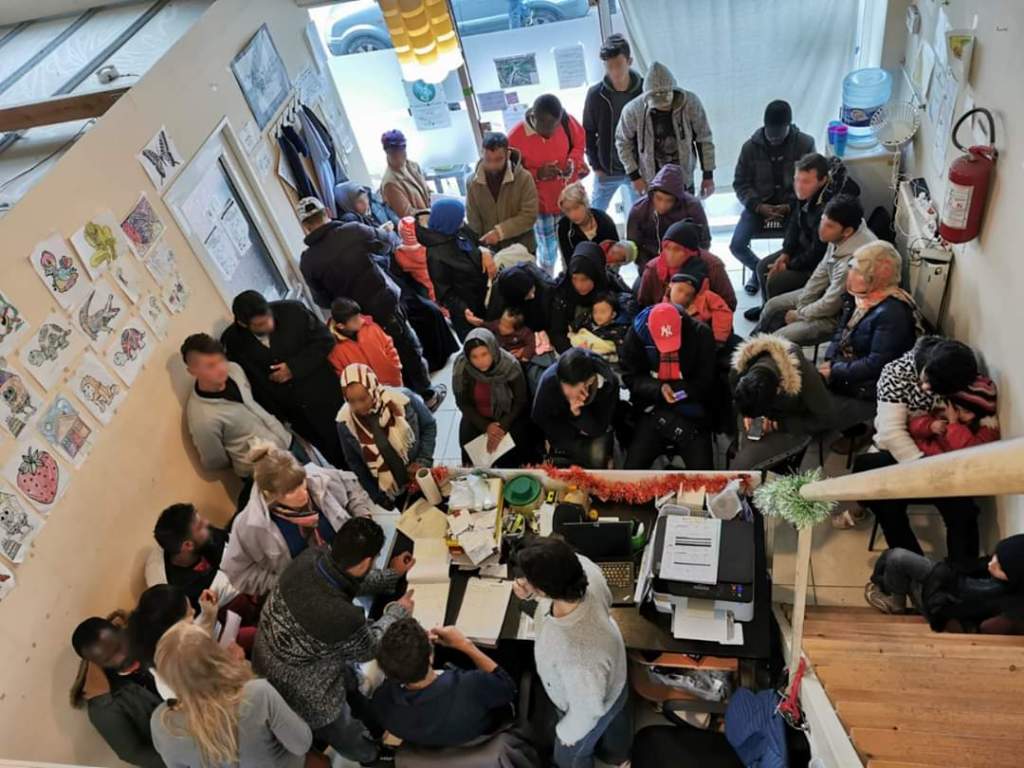
At the Med’EqualiTeam clinic, we have 7 consultation rooms and we see between 150 to 200 patients a day. In order to be seen by one of our doctors, patients come at 7:00 in the morning and queue up to have their name put on the waiting list. First, we do triage where we can quickly fix the easiest cases then consultations for cases that require more time. In the case of an emergency, we can refer patients to the hospital. However, knowing that it is overloaded, it has to be a true emergency. It’s hard to tell people everyday they will only get treatment at the hospital in the case of a life-threatening emergency. It’s hard to tell people that we have doctors but that we are not an official hospital, we are an NGO that can only provide pain killers like paracetamol and ibuprofen. We have antibiotics and other basic treatment options of course but no opioids or strong painkillers, nor treatment for specific conditions. We do not do injections. We do not have exploratory equipment like an X-Ray machine or an MRI. We can do blood and urine tests to measure basic values. That’s it. But that’s already something.
We provide emergency care in a way. And that would be just fine in the case of an emergency situation where people would only stay for a few days or weeks. Except that in this case, refugees are stranded on this island for way too much time. This is where the problem lies, I think. One of many problems. An infrastructure made for a temporary situation but this temporary situation drags on.
Physiotherapy
Picture from MedEquali Team social media
I see all sorts of patients; this is very varied work for me. I work in English or French and then Farsi and Arabic with interpreters. Beautiful team work. However, considering the situation, I also spend a lot of time listening and talking. And it’s not always very joyful to listen to or tell.
I explain to a patient with disc herniation in the acute phase, who sleeps on the ground in the cold and actually has not been able to sleep for days, that his case is not vital so for now the only thing he can do is wait. We would give him paracetamol and I would see him in physio every 10 days for 45 minutes to provide care and teach him some exercises that would help relieve the pain a little bit, maybe, I hope, Inch ‘Allah. I tell my patients with damaged knees that they would normally, in a normal healthcare system, with a meniscus and with torn cruciate ligaments, have physio several times a week, that we would do an MRI to figure out exactly what is going on, that we would plan a procedure and rehab after that. But here, they won’t get any of that. I will only see them every 10 days, will give them a splint or crutches if I have them, and that’s it. They need to wait for a transfer to a country where they’ll be able to receive adequate care. These are just examples among many others, among head trauma, stroke, and other injuries. There is this one patient also. He has had ankylosing spondylitis for 10 years; his spine is significantly deformed in spite of his young age and he does not carry his disease-modifying treatment with him. He will only be seen by the camp doctor in 3 months and in the meantime, we give him anti-inflammatory pills. So that makes him laugh a little bit considering the pain he has but that makes him cry also. I hear people on a regular basis wondering if it is really worth being alive in such conditions.
Stories of people who ended up here are pretty terrible. Violence broke them, they have experienced torture back home and fear is anchored in their body. They hurt everywhere. Sometimes, I can hardly put my hands on their back because their pain system is saturated and sensitized. The pain as well that they feel when they see that dogs get better treatment than people here on this island. Indeed, even dogs have a house to sleep in, and not them. One day, a fire broke out in the camp and some people fled and went to town. One patient told me he hid in someone’s yard to sleep but the owner of the house got scared and shot him. Hand injury only. But trust and soul damaged though. It’s hard to believe in people in these conditions.
It’s hard. Hard to hear and hard to say.
But this is reality in the field.
Patients’ smiles, a little bit of hope
Picture from MedEquali Team social media
Thankfully there are times where as a physiotherapist I can help someone. Smiling and finding hope again with patients who slowly get better or are just thankful because back in their country caregivers don’t take the time or don’t have the necessary resources. Or when there was simply no access to care.
Alleviating pain, by manual therapy, massages, teaching exercises, encouraging, giving an appointment for in 10 days and saying “On that day, I will be there for you”. Reassuring people, sharing one’s clinical reasoning or diagnosis, helping the patient understand the condition and pain to better manage it. Providing a splint to a patient whose knee or wrist is painful and then finally alleviating the pain a little bit. Giving crutches to a young person who has a limp since childhood because of a hip malformation and walks for the first time with a walking stick and a big smile on his face. Relaxing a painful neck, an aching back, an ankle that hurts. Sometimes, just being a careful listener, being there for the patient and considering him or her as a person, a person as a whole, alive, a human being. Cracking a stupid joke and making a patient laugh even though their ribs hurt and saying sorry but at the same time knowing that laughing caused as much good as harm.
Hope is the best medicine. Reminding them that where we are is not Europe, it is a refugee camp, not real life, just a fucking no man’s land where human rights are not really observed because of the lack of resources. Hoping and wishing that one day all of this will only be a bad memory, a transition, and that finally they will have the right to decent living conditions. In the meantime, there is life. And we hold on to it.
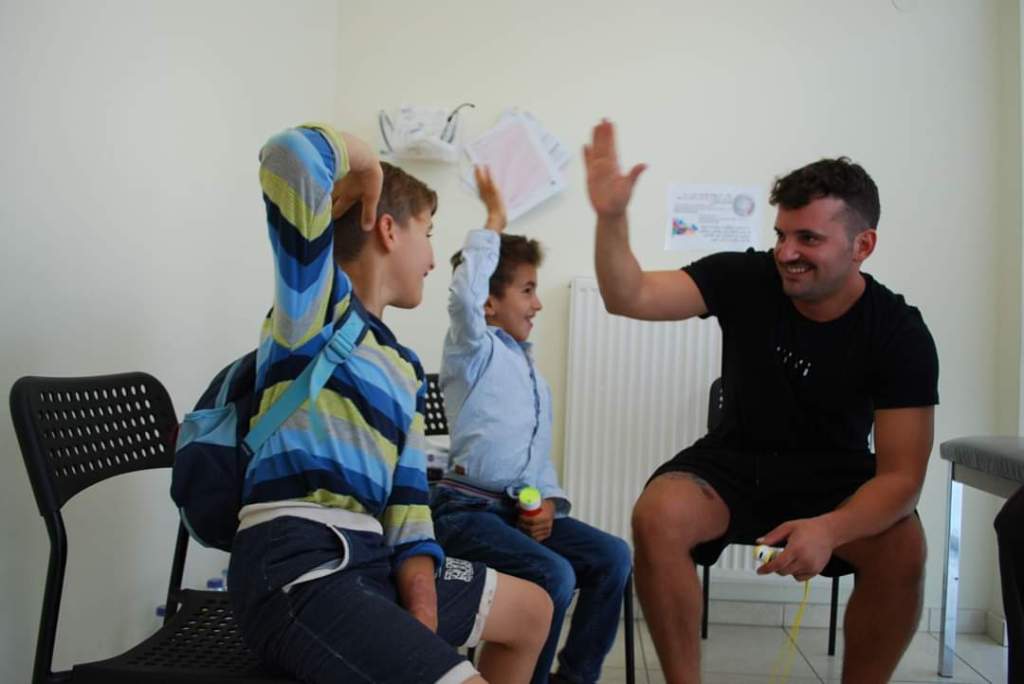
Sometimes also just playing with children in the waiting room, learning a few words in Farsi or Arabic, hanging out with the volunteer interpreters who work with us and who also have lived or still live at the camp. Teamwork. It feels good sometimes not to be alone with a patient. We support each other. We take care of one another. One of them always asks in the morning: “Still alive?” with his beautiful smile and his patience that seems to have no end even though we know that every one has their limits. Laughing with coworkers but also with patients sometimes. This young guy with both hands burnt following the explosion of a gas bottle used for cooking and who seems to be happy to have on one harm a very pretty blond English nurse dressing his wound and on the other harm a short blond Swiss physiotherapist moving his hand. Sometimes just a little something can bring a smile back on someone’s face. Running into a patient in the street who gives me a big hug and tells me they are doing better. Knowing that a lot of patients are happy to see us, we are often told at the clinic that we treat patients with kindness, as human beings and that it makes them feel good.
There are many instances where we actually help, it is reassuring and gratifying. We do a good job. Every day.
In Switzerland, I used to work 3.5 days a week and that was more than enough. I wouldn’t have wanted to work more than that. Here, I work 5 or 6 days a week and I don’t count my hours because…patients need us so much. I really enjoy the fact that I can help them with physiotherapy and by my being here. It has meaning, really. When it rains too much, patients for physio cannot always make it to the clinic. I then work as a French-English interpreter for doctors. There is always something to do, even physio for volunteers and coworkers. Or just cheering someone up. And the team needs it. They really need it.
We take care of each other and the team, after work. We share our feelings, joy or pain, or on the contrary we decide to forget everything and we cook together, we listen to music. Sweet mix of cultures. We work out a little bit, even though we often get off work after 10 hours spent at the clinic, sometimes more, and it is night time already. Sometimes we just hang out and we don’t say a word because we already have used all the words we had for that day and all we need is just each other’s presence.
So, this was in a few snapshots and insights, my experience and life here in Samos. Sometimes I don’t understand borders, war, violence. But this is the way it is. We need to keep fighting. Stay hopeful.
This was news from Samos, through the eyes of a Swiss physiotherapist. So many terrible things but at the same time so much support and mutual aid.
Here, we always need doctors, nurses, physiotherapists and volunteers. And financial support. And we need Europe to treat people like people. That’s the most important thing, I think.
Information needs to be shared as well. We just need people to know a little bit what is going on here, on Europe’s doorstep. So many people don’t even know. Six months ago, I myself didn’t know anything about all of this. Nothing. And it’s so close from home, from us, that people experience these terrible things. It’s crazy.
Sometimes, just sharing information helps. Sharing, always and forever.
Pass it on, get informed, open your ears to the world.
That is already something
Many many many thanks to Angelique for the translation. Thanks for teaching us about interpretation in medical care here in Samos. It was great to work with you.
Esquisses d’une journée à la clinique de Samos, Grèce, camp de réfugiés, comme physiothérapeute
« Je commence avec une femme victime de torture il y a 1 an et des poussières, sa clavicule cassée n’a pas solidifié correctement, déformation visible. Elle a très mal à chaque mouvement de bras. Presque impossible de mobilisera. Je me sens impuissante. Je travaille à distance, nuque, dos, respirations. Puis petit à petit se rapprocher de l’épaule. La douleur parfois est comme un animal sauvage qu’on cherche a apprivoiser. Ma patient parle, je l’écoute, je suis là pour elle. Plus tard dans la journée, en tant qu’interprète français-anglais pour un de nos médecins, j’explique au patient qu’on va devoir ouvrir son abcès infecté et douloureux pour vider le pus, mais qu’on n’a pas d’anesthésiant, et que l’hôpital ne le prendra pas en charge pour ça, alors on va lui donner 1g de Dafalgan, et je vais lui tenir les bras pendant que le médecin ouvre l’abcès au scalpel, histoire qu’il ne bouge pas et qu’on ne le blesse pas plus et qu’il ne blesse pas le médecin non plus. Je le rassure et je le tiens. Il a mal. Il crie mais il tient le coup. J’ai mal pour lui. Je passe dans le couloir et je vois un patient qui attend le docteur, il a des plaies ouvertes aux avant-bras, des coupures, tentative de suicide ou automutilation? Je ne sais pas. Un appel à l’aide dans tous les cas. On va s’occuper de lui. Il n’a pas l’air bien. C’est dur à entendre et à voir. Ça me met en colère aussi. La colère va au dessus de la tristesse et de la fatigue et me donne envie de me battre pour eux. De leur donner de mon temps et de mes connaissances et un peu de douceur aussi là au milieu. Juste un sourire des fois pour éclairer la journée brièvement.
Il y a aussi des cas faciles, ces patients que je peux aider, soulager, qui iront vite mieux grâce à nos soins. Belles surprises parfois, comme mon patient brûlé aux deux mains qui récupère étonnamment vite, 15 jours après l’accident, les plaies sont propres. Ça me met trop la joie, et lui aussi. Puis après le travail, un patient afghan que je croise au supermarché, trop content que je lui dise « Salam, khoubi? Khoubam » (« Bonjour ça va? Ça va bien » En farsi). Revoir des patients et apprendre qu’il vont un peu mieux. Ou juste qui remercient de notre gentillesse. Passer du temps le soir avec les autres volontaires, dont nos interprètes farsi et arabes, qui sont aussi des réfugiés. Certains ont déjà leur papiers mais ont décidé de rester ici pour aider, ou sont revenus exprès. Ils me donnent le courage qu’il y en a certains qui sortent de là. Il y a de l’espoir. «
Mon regard en tant que physiothérapeute ici à Samos. Différents éclairages, différents ressentis.
De plus en plus froid
Il y a trois semaines, en arrivant, je me disais que les conditions n’étaient pas si catastrophiques. On m’avait décrit un tableau très noir de la situation, mais les réfugiés que je voyais à la clinique avaient au moins des tentes pour s’abriter, de quoi se nourrir, se vêtir. La plupart ont des téléphones portables et peuvent contacter leur famille au pays, et je les vois vivre, sourire. Je découvrais alors la situation depuis ma petite bulle, car les ONG ne sont pas autorisées à aller au camp. Ce sont les réfugiés qui viennent nous voir ici dans la petite ville de Samos.
Ces derniers jours cependant, mon regard a changé. Ma compréhension et ma perception des choses aussi. Il fait également de plus en plus froid, il pleut presque tous les jours, et il pleut beaucoup. Les tentes au camp sont dans un terrain en pente, boueux. C’est un combat pour certains réfugiés que de rester au sec. Ils n’ont pas assez d’habits chauds ou étanches. J’ai de nombreux patients qui viennent me voir en tongs et en short et j’ai froid pour eux. Comme ils n’ont ni l’eau ni l’électricité au camp, ça devient vraiment limite. Chaque jour des cas de grippe, des sinusites, des diarrhées, des maux de ventre, des petites maladies qui devraient passer facilement mais ne passent pas à cause des mauvaises conditions, voire s’empirent. Les douleurs habituelles (mal de dos, de nuque, de ventre, sciatiques, problèmes articulaires) sont exacerbées par ces conditions. La surpopulation au camp fait qu’il y a régulièrement des bagarres. Des violences qui éclatent. L’endroit n’est pas sûr pour bon nombre d’entre eux.
Je vous parle du corps, mais le plus dur ici pour eux, je crois, c’est la souffrance psychologique, la souffrance émotionnelle. Elle est grande, pour beaucoup. Ce qui est terrible, c’est l’incertitude et l’attente. Ne pas savoir s’ils vont être renvoyés aux pays, qu’ils ont fui car le danger était trop grand. Guerre, terrorisme, tortures ou abus. La plupart des réfugiés attendent des mois ici à Samos. Certains 1 à 2 ans avant de savoir ce qui va leur arriver. C’est long, des mois, quand les journées ne passent pas et qu’il n’y a rien à faire qu’attendre dans l’inconfort.
L’incompréhension aussi, de la situation, de ce qui leur arrive. Il y en a beaucoup qui viennent de petits villages, ils ont peu d’éducation donc peu de connaissances du corps et de la médecine. Alors ils peuvent rapidement s’effrayer pour de petites choses, juste parce qu’ils ne savent pas. Par exemple un patient pensait avoir la gale – et nous en avons, des vrais cas de gale – suite à des démangeaisons intenses. Il avait juste la peau sèche. Un patient super inquiet par un kyste au poignet, rien de grave, mais il se demande s’il va perdre sa main. Légitime la peur, quand on ne connait pas. Comme moi et la mécanique auto en quelque sorte.
Leur accès aux soins de base est très limité. Il y a un seul hôpital à Samos, et il est surchargé. Chaque réfugié doit voir le médecin du camp, mais comme il n’y a qu’un médecin pour 7000 personnes, ils ont souvent leur rendez-vous dans 3-4 mois. L’impression qu’ils vont crever avant. En ce moment, il n’y a que deux dentistes disponibles pour eux. Ils ne voient les gens que si ça fait deux mois qu’ils sont là, à leurs frais, 50 euro la consultation, et s’ils ont un traducteur parlant anglais. Il n’y a pas assez d’ophtalmologues, de rhumatologues et d’orthopédistes, trop peu de psychologues. Ils sont débordés donc très difficiles d’accès. En ce moment, nous n’avons pas moyen de référer tous les patients qui évoquent des idées suicidaires. Malheureusement, il y en a régulièrement. La disponibilité des différents acteurs médicaux est très variable, les associations étant le fruit de volontaires, de bénévoles. Mais ce qui est constant, malheureusement, c’est le manque d’infrastructure.
Les soins médicaux
Picture from MedEquali Team social media
A la clinique de Med’EqualiTeam, nous avons 7 salles de consultations. Nous voyons entre 150 et 200 patients par jour. Pour être examinés par un de nos médecins, les patients viennent à 7h du matin et font la queue pour être sur la liste. Un triage d’abord, où nous pouvons rapidement régler les cas simples, puis les consultations pour les cas qui nécessitent plus de temps. En cas d’urgence, nous référons à l’hôpital. Le sachant surchargé, le tri est important et peu y ont accès. C’est dur chaque jour de dire à ces gens que l’hôpital ne les soignera pas sauf si leur vie est en danger immédiat. Nous sommes une ONG, et avons peu de médicaments à disposition. Principalement du paracétamol et des ibuprofens pour la douleur. Des antibiotiques et différents traitements de base, peu d’opiacés ou d’antidouleurs puissants, pas de médicaments spécifiques à certaines pathologies. Nous ne faisons pas d’injections ou dans certains cas spéciaux. Nous n’avons pas d’outils d’analyse type radio ou IRM. Nous faisons des prises de sang ou des analyses d’urine et mesurons les valeurs de base. Nous avons un suivi des plaies et bandages. C’est tout. Mais c’est déjà ça.
Nous avons des médecins mais notre statut ne nous permet d’offrir que des soins primaires uniquement. Ce qui irait très bien dans une situation d’urgence où les gens restent quelques jours / semaines. Sauf que là, les réfugiés restent coincés ici sur cette île beaucoup trop longtemps. Il est là le souci je crois. Un des soucis. Une infrastructure pour une situation temporaire, mais une situation temporaire qui s’éternise.
En physiothérapie
Picture from MedEquali Team social media
Je vois tous types de patients, le travail de physiothérapeute est super varié. Je travaille en anglais ou en français, puis en farsi ou en arabe avec des interprètes. Un beau travail d’équipe.
Vu la situation, je passe beaucoup de temps à écouter, à dialoguer. Les histoires que j’entends ne sont souvent pas belles ni joyeuses; mes discours se veulent encourageants mais la réalité du terrain les rendent difficiles également.
J’explique au patient avec son hernie discale en phase aiguë, qui dort par terre au froid et qui justement ne dort pas depuis des jours, que son cas n’est pas un cas vital, alors pour l’instant il doit juste patienter. On lui donnera du paracétamol et je le verrai en physio 45′ chaque 10 jours, pour du soins et lui enseigner divers exercices qui le soulageront un peu, peut-être, j’espère. Inchallah. J’explique à mes patients avec des importantes lésions des genoux que normalement, dans un système de santé fonctionnel, avec un ménisque et ligament croisé déchirés, ils auraient de la physio plusieurs fois par semaine, un IRM pour savoir ce qu’il en est vraiment, une opération probablement de planifiée et une rééducation ensuite. Mais qu’ici, ils n’auront rien de tout ça. Je les verrai chaque 10 jours et leur donnerai une attelle ou des béquilles si j’en ai. C’est tout, il faut qu’ils attendent d’être transférés dans un endroit où ils seront suivis correctement. Des exemples parmi tant d’autres. Les traumatismes crâniens, les AVC, les amputés, blessures récentes ou anciennes. parfois jamais traitées. Il y a ce patient aussi, avec un spondylarthrite ankylosante depuis 10 ans, dont la colonne est nettement déformée malgré son jeune âge mais qui n’a pas avec lui sa médication de fond. Lui aussi ne sera vu par le médecin du camp que dans trois mois et en attendant on lui donne des anti-inflammatoires. Alors ça le fait un peu rire au vu des douleurs qu’il a, et un peu pleurer aussi surtout. J’entends régulièrement des gens qui se demandent si ça vaut vraiment la peine de vivre dans ces conditions-là.
Les récits des gens arrivés ici sont assez terribles. Des gens cassés par la violence, victimes de tortures au pays, qui ont gardé la peur dans leur corps et ils ont mal partout. Parfois je peux à peine poser mes mains sur leur dos tellement leur système de la douleur a été saturé et sensibilisé. Leur tristesse aussi, la tristesse de voir qu’on traite mieux les chiens que les gens ici sur l’île. Oui car même les chiens dorment dans les maisons, mais pas eux. Un jour où il y a eu un feu au camp, certains ont fui et sont venus en ville, un patient m’a dit qu’il s’était caché dans un jardin pour dormir, mais que l’habitant de la maison a eu peur et lui a tiré dessus. Juste la main blessée. Mais la confiance et l’âme surtout. Comment croire aux humains dans ces conditions.
C’est dur. Dur à entendre et dur à dire. Mais c’est la réalité du terrain.
Les sourires des patients, un peu d’espoir
Picture from MedEquali Team social media
Heureusement il y a toutes les fois où comme physiothérapeute je peux aider quelqu’un. Retrouver le sourire et l’espoir avec les patients qui vont mieux petit à petit ou qui juste remercient car au pays soit les soignants ne prenaient pas le temps ou n’avaient pas de moyens, soit ils n’avait pas accès à des soins.
Diminuer un peu la douleur, par la thérapie manuelle, les massages, enseigner des exercices, encourager, donner un rendez-vous dans 10 jours et dire « Ce jour-là, je serai là pour vous ». Rassurer, partager son raisonnement clinique ou son diagnostic, aider à mieux comprendre la pathologie, la douleur pour mieux la gérer. Proposer une attelle à un patient dont le genou ou le poignet est douloureux et que la douleur se calme enfin un peu. Donner des béquilles à un jeune qui boite depuis son enfance à cause d’une malformation de la hanche et qui marche pour la première fois avec une canne et a le sourire jusqu’aux oreilles. Détendre une nuque douloureuse, un dos meurtri, une cheville qui fait mal. Parfois aussi juste être une oreille attentive, être là pour le patient et le considérer comme une personne, une personne entière, vivante, un être humain. Faire une blague nulle et faire rigoler son patient qui a mal aux côtes et s’excuser et en même temps savoir que rire lui fait autant de bien que le mal causé. L’espoir comme meilleur remède. Rappeler que là où on est ce n’est pas l’Europe, c’est un camp de réfugiés, pas la vraie vie, juste un putain de No Man’s Land où les droits de l’homme ne sont pas vraiment respectés par manque de moyens et de volonté. Souhaiter et espérer qu’un jour tout cela ne sera qu’un mauvais souvenir, une transition, et qu’enfin ils auront droit à des conditions de vie dignes de ce nom. En attendant les conditions, ils ont la vie. Et on s’accroche à ça.
Parfois aussi juste s’amuser avec les enfants qui attendent à la réception, apprendre des mots en farsi et en arabe, passer du temps avec nos volontaires interprètes qui eux aussi sont passés par le camp ou y sont encore, et travaillent avec nous. En équipe. C’est bon parfois de ne pas être seul avec le patient. On se soutient. On veille les uns sur les autres. L’un d’entre eux, chaque matin nous demande « Still alive? » avec son beau sourire et sa patience qui semblent sans fin; même si l’on sait que chacun à ses limites. Rigoler avec les collègues mais aussi avec les patients parfois. Ce jeune brûlé aux deux mains suite à l’explosion d’une bonbonne de gaz pour cuisiner et qui semble bien content d’avoir à un bras une jolie infirmière anglaise blonde qui refait son pansement et à l’autre une petite physio suisse blonde aussi qui mobilise sa main. Il suffit parfois de peu de choses pour retrouver le sourire. Croiser une patiente dans la rue qui vient me faire un gros câlin et qui dit qu’elle va mieux. Savoir que beaucoup de patients sont contents de nous voir, on nous dit souvent qu’ici à la clinique on traite les patients avec gentillesse, qu’on les traite comme des humains, et que ça leur fait du bien. Il y a plein de cas où on aide, c’est rassurant, gratifiant. On fait du bon travail. Tous les jours.
En Suisse, je travaillais 3,5 jours par semaine et ça me suffisait largement. Je n’aurais pas eu envie de travailler plus que ça. Ici, je fais 5 à 6 jours par semaine, et je ne compte pas les heures car … les patients ont tellement besoin de ça. J’aime tant le fait de pouvoir les aider avec la physiothérapie, et par ma présence, ça a du sens, vraiment. Quand il pleut trop, les patients physio parfois n’arrivent pas toujours à venir, alors je fais interprète français-anglais pour les médecins, il y a toujours quelque chose à faire, même de la physio pour les volontaires, les collègues. Ou juste remonter le moral des troupes. Elles en ont besoin les troupes. Elles en ont besoin.
On prends soin les un des autres, dans l’équipe, après le travail. Partager sur nos ressentis, nos joies, nos peines, ou au contraire oublier tout ça le soir et cuisiner ensemble, écouter de la musique, doux mélange de cultures. Faire un peu de sport, même si souvent on sort de la clinique 10h après y être entré, parfois plus, et qu’il fait déjà nuit. Parfois juste se poser ensemble et ne pas parler, car on a déjà épuisé tout notre stock de mots pour la journée, et qu’on a juste besoin de nos présences.
Voilà, c’était quelques aperçus, éclairages sur mon expérience, ma vie à Samos
Ce sont les nouvelles de Samos, à travers mon regard de physiothérapeute suisse. Tant de choses terribles et en même temps tant de soutien et d’entraide.
Ici, il y a besoin régulièrement de médecins, d’infirmières, de physios, de volontaires. Et de soutien financier. Et surtout que l’Europe traite ces gens comme des gens. Surtout cela je crois.
Mais aussi besoin de transmettre les informations.
Juste que les gens sachent un peu ce qu’il se passe ici, aux portes de l’Europe. Tellement de gens ne savent même pas. Moi, il y a six mois, je ne savais rien de tout ça. Rien. Je savais pas qu’en Afrique dans certains pays tous les jours des gens sont assassinés et torturés et que les gouvernements laissent faire ca depuis des années. Je savais pas qu’aux portes de l’Europe des gens restent bloqués des années dans des tentes sans acces à des sanitaires ou à des soins basiques. Je savais pas. Et c’est juste à côté de chez moi, de chez nous, que ces gens vivent des choses terribles. C’est fou. Alors parfois, juste transmettre l’information, aide.
Transmettre, encore et toujours.
Partagez, renseignez-vous, ouvrez les oreilles sur le monde
Texte de Clara, étudiante en médecine avec qui j’ai travaillé ces deux derniers mois, 06.03.2020 :
Samos, la honte aux portes de l’Europe
Cela fait trois jours que j’ai quitté précipitamment l’île grecque de Samos après avoir passé deux mois comme bénévole au sein de Med’EqualiTeam, une ONG médicale dispensant gratuitement des soins médicaux aux personnes réfugiées vivant dans le camp de Samos.
Le camp de Samos, destiné à l’origine à seulement 650 demandeurs d’asile est aujourd’hui saturé. D’après les chiffres de l’UNHCR c’est aujourd’hui 7 600 personnes qui s’y entassent. La majorité viennent de Syrie (36%), d’Afghanistan (22%), ou de République Démocratique du Congo (13%). Les mineurs représentent un tiers de la population. Après l’annonce par la Turquie de l’ouverture de ses frontières aux migrants, la situation est plus que critique sur les îles grecques. Lesbos, Chios, Samos font face depuis quelques jours à une arrivée massive de bateaux de migrants. Lesbos qui accueille déjà plus de 20 000 réfugiés fait face aux plus vives tensions. La colère des habitants explose, des groupes d’extrême droite bloquent les routes d’accès au camp pour les nouveaux arrivants et les accueillent sous les huées « Dégagez, rentrez en Turquie ! », s’en prennent aux humanitaires en saccageant leurs voitures ou leurs locaux. Plusieurs journalistes ont également été pris à partie, tout comme une responsable du Haut-Commissariat des Nations Unies pour les réfugiés. A la frontière terrestre greco-turque la situation n’est pas plus apaisée. Selon l’ONU, 13 000 migrants sont aujourd’hui massés aux postes frontières et repoussés par gaz lacrymogène. Car si Erdogan a bien ouvert ses frontières occidentales, il n’en est rien côté grec.
Suite aux évènements récents de ces derniers jours, une partie de notre équipe, fatiguée et craignant pour sa sécurité, a pris la décision de quitter l’île. Le retour en France est brutal, on laisse dernière nous les plus expérimentés de l’équipe qui malgré l’instabilité de ces derniers jours continue pour l’instant le travail. Cette équipe c’est une trentaine de personnes bénévoles ; ils sont infirmiers, médecins, pharmaciens, kinés, réceptionnistes, traducteurs (eux-mêmes réfugiés pour la plupart).Dans cette clinique, c’est entre 100 et 200 personnes qui sont vues par jour (6 jours/7 de 7h à 16h). Il y a des jours où c’est tellement bondé qu’on peine à se frayer un chemin entre les patients. Ces deux mois à Samos m’ont quelque part réconcilié avec la médecine. On peut réellement faire de belles choses avec peu de moyens. Dans cette prison à ciel ouvert qu’est Samos, je suis persuadée que nos soins, nos paroles, nos regards, nos gestes chaleureux apportent quotidiennement à toutes ces personnes un peu de réconfort.
Mon départ précipité à quelque peu entaché la fin de cette expérience, mais c’est ainsi. Je garde à l’esprit les sourires de certains patients à la fin des consultations, les rencontres inspirantes… en particulier les traducteurs réfugiés (sans qui le travail médical est juste impossible) devenus des amis. Ces amis n’ont pas la chance d’être nés, comme moi, dans le « bon » pays. Ils ont fui la guerre, les persécutions, la torture et se retrouvent à présent bloqués sur cette foutue île depuis des mois, voire des années sans l’ombre d’un entretien avec les autorités grecques. Et pourtant ils se lèvent tous les matins à 6h pour venir travailler à nos côtés à la clinique, nous traduisent les maux et les histoires de vies de leurs voisins de tente… Et malgré cela ils sont beaux, souriants, optimistes. Mais pour combien de temps encore ?
Sur cette île on prend pleinement conscience de cette notion de « frontière ». Pour moi, comme pour le reste de l’équipe, il a été plus qu’aisé de quitter cette île une fois la décision prise. En deux clics sur internet, avec ma simple carte d’identité en main, mon billet retour était acheté et 24 heures plus tard j’atterrissais à Marseille. Ça nous paraît anodin, ça l’est effectivement pour nous français. Ca l’est beaucoup moins pour mes amis traducteurs et les 7 600 personnes du camp de Samos.
Med’EqualiTeam fonctionne uniquement à travers les dons, les financements participatifs et le soutient d’autres ONGs. Ces derniers jours, afin d’anticiper au mieux la pression croissante qui pèse sur l’île, la clinique a d’ores et déjà commencé à stocker du matériel médical. Elle a plus que besoin de s’assurer qu’elle aura toujours suffisamment de médicaments, de pansements et de produits de bases.
Text from Clara, who I worked with on Samos, Greece. People need to know.
Samos, shame on the doors of Europe
It’s been three days since I left the Greek island of Samos after spending two months as a volunteer at Med EqualiTeam, a medical non-medical NGO providing free medical care to refugees living in the Samos camp.
The Samos camp, originally intended for only 650 asylum-seekers, is now saturated. According to the figures of the UNHCR, there are 7000 people who pile up there today. The majority are from Syria (36 %), Afghanistan (22 %), or the Democratic Republic of Congo (13 %). The minors account for one third of the population. After Turkey’s announcement of the opening of its borders to migrants, the situation is more than critical on the Greek islands. Lesvos, Chios, Samos have been facing a massive arrival of migrant boats for the past few days. Lesvos, which is already hosting more than 20000 refugees, faces the greatest tensions. The anger of the inhabitants explodes, far-right groups block the roads of access to the camp for newcomers and welcome them under the « Get out, go back to Turkey », take care of the humanitarian people by trashing their cars or locals .. Several journalists were also caught, as was a head of the Office of the United Nations High Commissioner for Refugees. At the Turkish-Turkish land border, the situation is no more peaceful. According to the United Nations, 13 migrants are now being massed at border posts and being pushed back by tear gas. Because if Erdogan has opened his western borders well, he is not the Greek side.
Following the recent events of the past few days, a part of our team, tired and afraid for their safety, has made the decision to leave the island. The return to France is brutal, we are left last the most experienced of the team who despite the instability of the last few days continues the work for now. This team is about thirty volunteers; they are nurses, doctors, pharmacists, physios, receptionists, translators (mostly refugees). In this clinic, between 100 and 200 people are seen a day (6 days / 7 from 7 am to 16 pm). There are days when it’s so crowded that you can’t make a way between patients. These two months in Samos have made me up somewhere with medicine. We can really do beautiful things with few means. In this open-air prison of Samos, I am convinced that our care, our words, our eyes, our warm gestures give all these people a little comfort daily.
My rushed departure somewhat damaged the end of this experiment, but so. I keep in mind the smiles of some patients at the end of the consultation, inspiring meetings… especially refugee translators (without whom medical work is just impossible) become friends. These friends are not lucky enough to be born, like me, in the « good » country. They have run away from war, persecution, torture and now have been stranded on this damn island for months or even years without a shadow of an interview with the Greek authorities. And yet they get up every morning at 6 am to come and work by our side at the clinic, we translate the evils and life stories of their tent neighbors… And despite that they are beautiful, smiling, optimistic .. But for how much longer?
On this island we are fully aware of this concept of « border ». For me, as with the rest of the team, it was easier to leave this island once the decision was made. In two clicks on the internet, with my simple identity card in hand, my return ticket was bought and 24 hours later I would travel to Marseille. It seems harmless to us, it is indeed for us French. This is much less so for my translators friends and the 7 people of Samos camp.
Med EqualiTeam works only through donations, participatory financing and supports it from other non-governmental organizations. In the last few days, in order to anticipate the increasing pressure on the island, the clinic has already started storing medical equipment. She needs to make sure she will always have enough medicine, dressings and basic products.
Tirej wisdom, one more time. His starfish storie I want to share with you. He told it to me two weeks ago. I was sad. Sad because my job is to release pain, and suffering. But so many time in Samos I was confronted to things I cannot change. It’s frustrating, and so hard. Too many sad stories to my ears. Too many sad stories.
What to say to your patient with a rhumatologic degenrative disease (ankylosing spondylitis) that we don’t have the treatement he is suppose to have and he will just wait in the terrible condition of the camp that his asylum request will be accepted – or maybe rejected – to go out of there and take care of his health properly? What to say to the young woman with total incontinence after being rape a couple of monthes ago, that was already saw a midwife from MSF but who was already told that we don’t have anything here to help her with urogynecology rehabilitation? What to say to the old man who would need surgery for his legs but will not have as well and struggle to walk? this old man, every time he comes to the physio told you again the story of his son dead by a wall that felt on them in his country in war. What to say to the man with two arthrodese wrist or worse, the one with amputated forearm after 14 unsuccesfull surgeries that cannot wash their clothes by hands, that I will not make a referal for laundry for them, because right now laundry tickets are just for scabies cases? What to say to patients that are so tired to be stucked there since monthes or years, exhausted, and tell you they would prefere to die than to live in those conditions? Patient with psychiatric difficulties, borderline personnality disorders, psychotics symptoms, voice talking to them, anxiety crisis waking them up in the night, that we don’t have psychologist for them to talk to? Telling you why am I so afraid? Everyone would be so afraid in those conditions, my dear. It’s so hard sometime to find the good words. No pill for hope, as used to write my friend Henry.
No pill for hope. But still, sometime, for patients, juste having someone listening to them make a huge difference. Someone who is there for them, treat them as humans – so many describe being treated like animals by the greek autorities – try to help a little bit, it’s so important. Health care professionals who take time to explain them and understand better their pathologies, what to do with the pain for now, in that transition time where the conditions are bad. Really bad. Encouraging them to keep hope it’s just a transition, just a time. No one will stay on Samos for ever. Even if the time doesn’t seem to pass sometime. No one is there forever. And if you are here, it does mean you already went through countries, throug a see on tiny a little boat. If you are here, you are stronger than you think you are. So just keep hope a little bit more. And pray . Those were my daily words, in physiotherapy. Fighting for hope.
Anyway, my fist idea was to talk to you about the storie of starfish:
"One day, somehwere, somehow, on a nice beach, after the tide went down, thousands and thousands of starfish were stucked on the sand, and drying in the sun. Thousands or maybe millions, I don't remember well. I was sad, I could only listen halfway through my tears. And a little girl was here, taking a starfish, and bringin it back to the sea, bringing it back to water, to life. An old man was walking around, and saw her. He aske her what's the point to save a starfish at a time, when still hundreds (thousands? million?) will die anyway. A couple of starfish will not make a difference. And she answered, that for each tiny little starfish she save, for that starfish, and then this starfish, it does make a huge difference. "
It does. Of course volunteering a couple of monthes on such a huge world crisis make you feel like it doesn’t make a difference. For world. Maybe even for all those 7600 refugee on Samos. But for every patient I saw, it does make a difference.
Thank you Tirej to remind me that.
And I do hope that hope and kindness have the ability to spread. On Christmas, an african woman told me she was so happy we were open on that day Because in africa, many hospital close. And her little daughtes died one year ago, on a Christmas day, because of that. She told me that seeing that we still work on Christmas and New Year made her want to help more people. When new women arrive in the camp, she did use to give them a blanket and shelter for the night. She did use to share her food. And slowly and slowly people does, as well. When she will be out of that hell, she want to work in an orphanage, maybe open one, one day. Kindness bring kindness, some times. I hope. Inchallah.
I get blessed those last monthes by God from arabic, farsi and african patients. I do hope god is god, there is one for everyone, and that slowly and slowly people will remember it and help each other, instead of fighting each other.


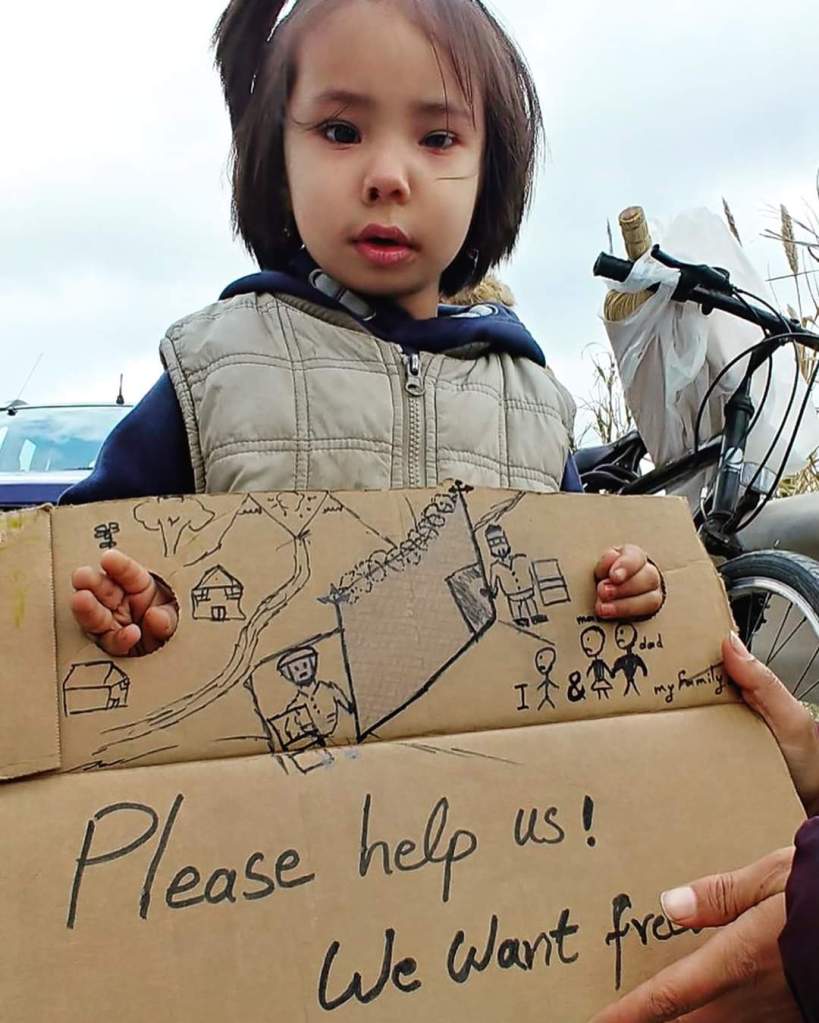
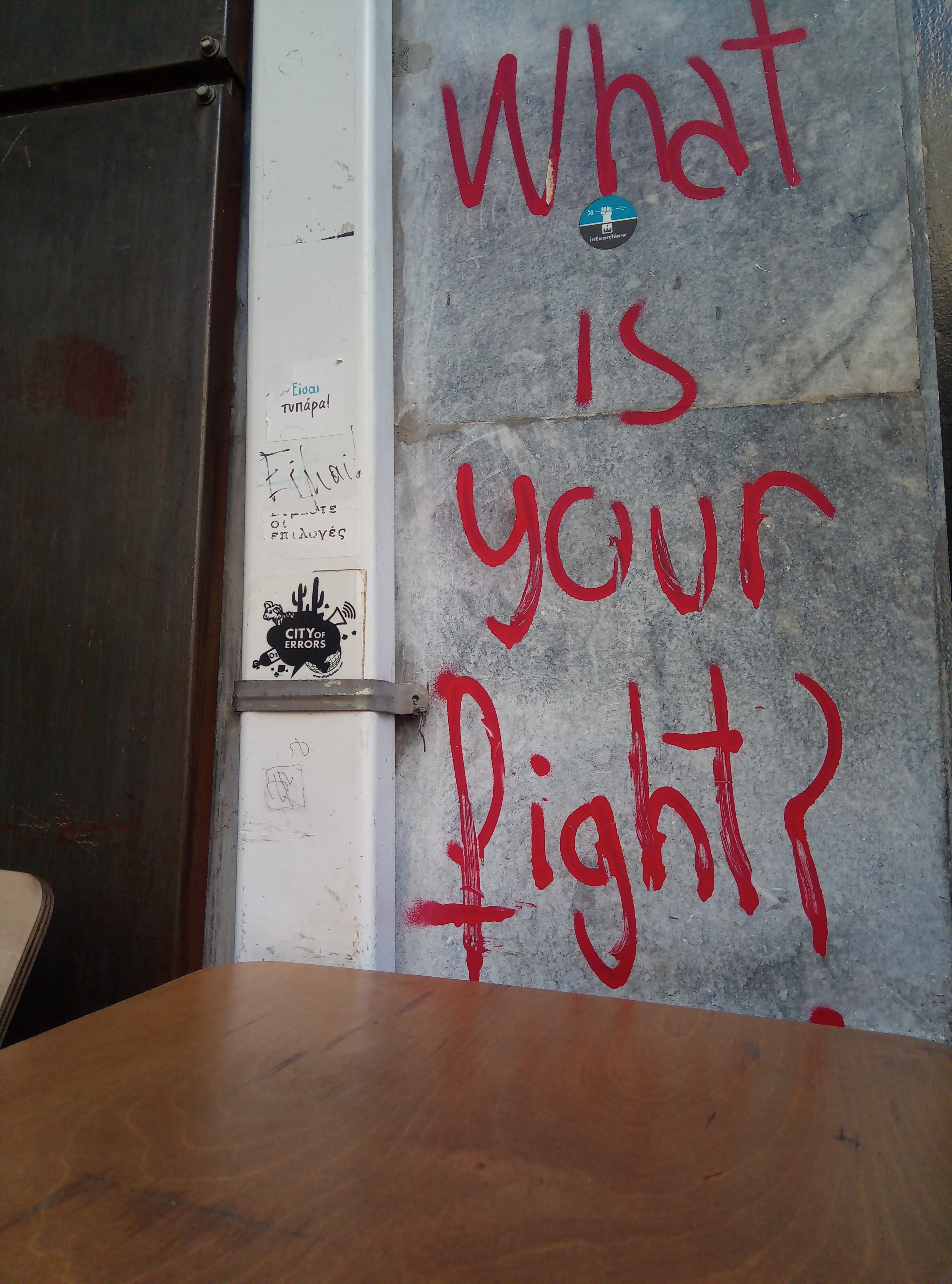
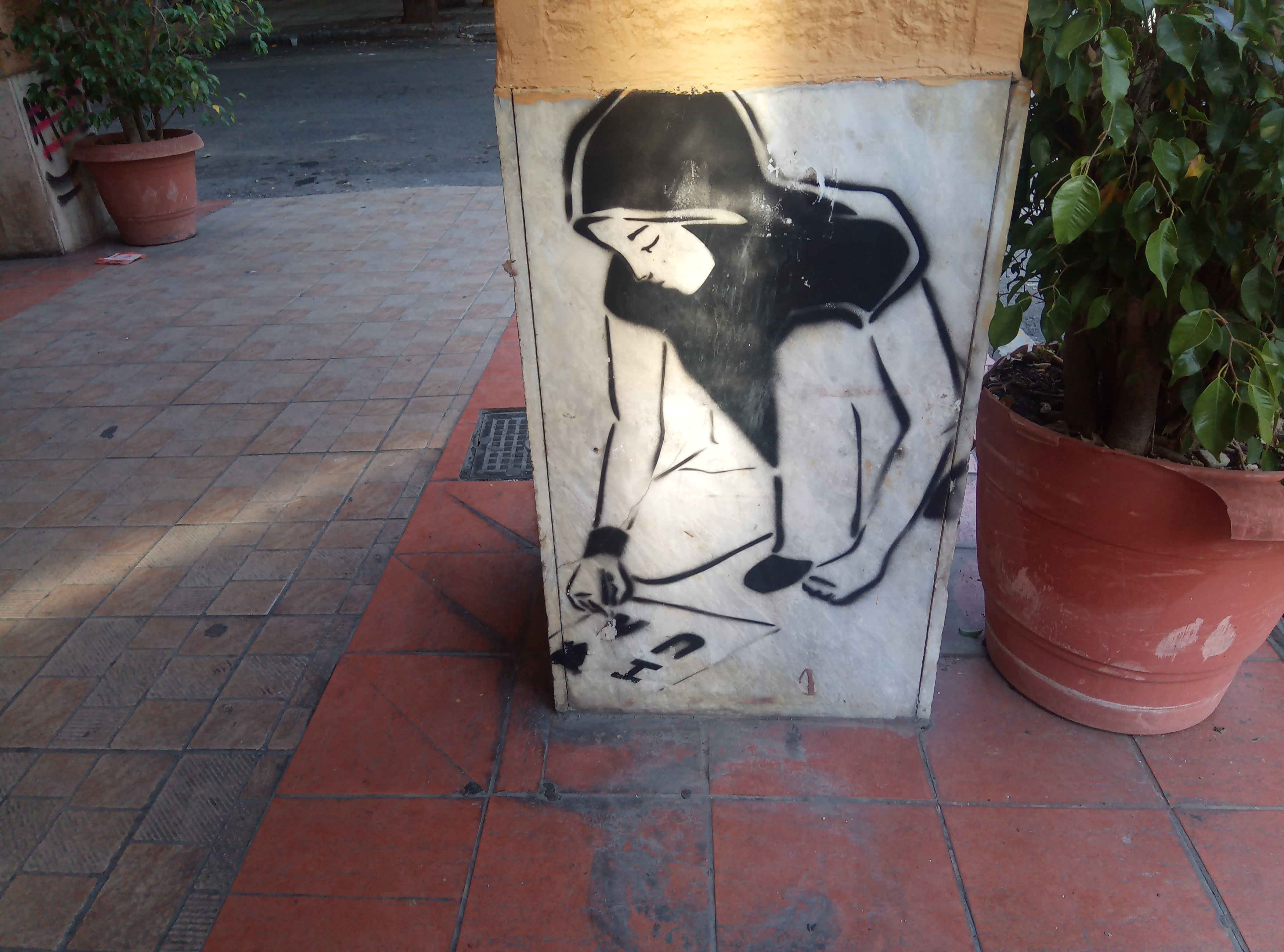


 Notes de voyage